
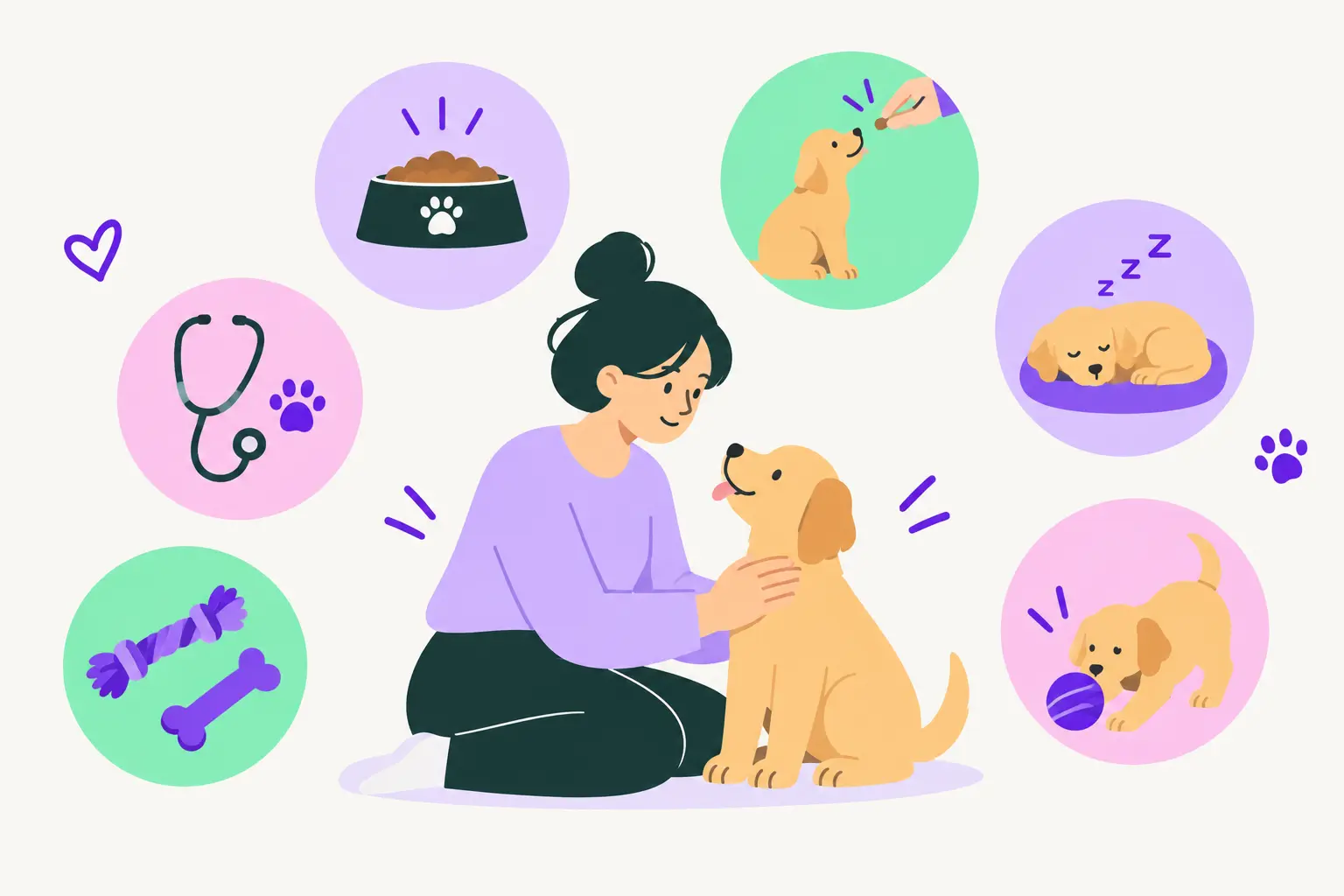
Please note: these guides are created for informational purposes only, are not medical data and do not replace veterinary advice. If your pet shows signs of health problems — unusual or atypical behavior, refusal to eat, or any other worrying symptoms — please do not self-medicate and take your pet to a veterinarian.
What to expect during puppyhood
Puppyhood is the earliest and most formative stage of a dog’s life. During this period, dogs rapidly develop habits, reactions, confidence, and social understanding of the world around them.
Raising a puppy is not only about care, but about helping the dog adapt safely and gradually to human environments, routines, sounds, and interactions.
The first days at home
Moving into a new home can be stressful for a puppy. New smells, unfamiliar people, and separation from littermates create a major environmental change.
The first days should remain calm and predictable. A quiet resting space and stable routine help the puppy adapt more comfortably.
A sample first-week schedule
The first week is for adaptation, not education. A simple rhythm works well: wake up and go outside immediately, short play, breakfast, a long calm rest, a short walk, rest again, an evening walk, dinner, and quiet time before bed.
Keep visitors, trips and noise to a minimum during this week. The puppy only needs to learn two things: where its place is, and that the household is predictable.
House training: a practical routine
Take the puppy outside right after waking up, after every meal, after play, and before sleep. Puppies of eight to ten weeks usually need to go every two to three hours; older puppies can wait longer.
Choose one spot and use the same phrase each time. Praise or treat the puppy immediately after it finishes — the reward must come within a second or two to stay connected with the action.
Accidents are part of the process. Clean the spot with an enzyme cleaner so the smell does not invite a repeat; punishment after the fact only teaches the puppy to hide from you while eliminating.
Early socialization
Early socialization introduces the puppy to different environments, sounds, surfaces, people, and situations. Positive early experiences help build confidence and adaptability later in life.
Socialization should happen gradually and without overwhelming the puppy. Too much stimulation at once can create stress instead of confidence.
A socialization checklist
Make a short list and work through it slowly: different surfaces (grass, pavement, metal grates, laminate flooring), common sounds (vacuum cleaner, traffic, doorbell, fireworks recordings at low volume), and calm people of different ages and appearances.
Pair each new experience with something the puppy likes — food, play, or attention — and end the session before the puppy becomes overwhelmed. Three short positive encounters teach more than one long overwhelming one.
How much walking is right
A common rule of thumb for growing puppies: about five minutes of structured walking per month of age, twice a day. A three-month-old therefore gets roughly fifteen minutes per walk, plus free play at home.
Surfaces, sounds and slow exploration matter more than distance. Avoid forced long marches, excessive stairs, and running beside a bicycle while the joints are still forming.
Sleep and daily rhythm
Puppies sleep significantly more than adult dogs and require frequent rest periods. Overtired puppies often become more restless, reactive, or difficult to calm.
A stable daily rhythm helps regulate energy and improves adaptation to home life.
Where the puppy sleeps
Choose one quiet corner — not a corridor and not a draughty spot. A bed or a crate of the right size: the puppy should be able to lie fully stretched out and turn around comfortably.
The first nights are often noisy. A warm hot-water bottle and a soft ticking clock can mimic the littermates; decide in advance whether the puppy may sleep in your bed, and keep that rule consistent from day one.
Teething and chewing phase
During teething, puppies naturally explore objects through chewing. This stage is temporary but requires patience and proper management of the environment.
Safe chew toys and supervision help redirect destructive chewing behavior.
Biting and bite inhibition
Puppies explore and play with their mouths, so biting is normal. Teach bite inhibition by stopping the game the exact moment teeth touch skin: stand up, turn away, wait a few seconds, then resume play.
Never use your hand as a toy. If the puppy bites too hard, yelp once, go quiet and pause the game; over a few weeks the bite pressure softens naturally.
Building confidence
Confidence develops through repeated positive experiences and predictable routines. Gentle exposure to new environments helps puppies learn that unfamiliar situations are safe.
Fearful reactions during puppyhood are normal and should be handled calmly rather than punished.
Teaching to be alone
Being alone is learned, not innate. Start with tiny departures: stand up, step out for three seconds, come back — and stay boring. Repeat until the puppy stays completely calm.
Then increase the time gradually: a few seconds, then a minute, then several minutes. Leave a predictable cue — a long-lasting chew or a stuffed toy — and never make arrivals or departures emotional events.
Puppy-proofing your home
Get down to the puppy's eye level and remove what it can reach: cables, small objects, shoes, cleaning products, toxic plants and dangling curtains. Closed doors beat constant supervision.
Secure the trash bin, keep bathroom doors closed, and use baby gates to limit the first weeks to one or two rooms. The smaller the free space, the fewer mistakes everyone has to correct.
First veterinary visits
Book a check-up in the first days after moving in. The vet will examine the puppy, discuss the timing of vaccinations and deworming, and answer feeding questions — take a written list of those questions with you.
Ask for a pet passport or health record, note the microchip number, and keep all documents in one place: you will need them for travel, grooming, insurance, and later for any specialist consultation.
Conclusion
Puppyhood is a short but extremely important developmental stage. Stable routines, gradual socialization, patience, and a safe environment help create a more confident and adaptable adult dog.