
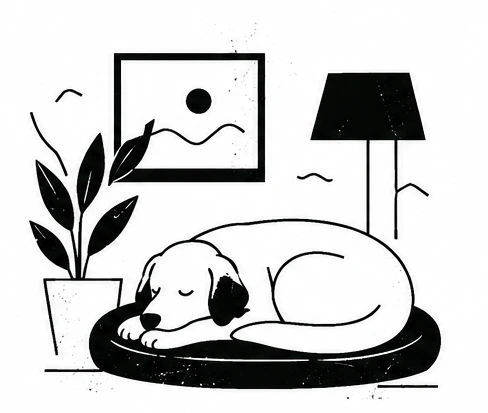
What “living with a dog” actually means
Living with a dog is primarily about organizing your daily life around another living being that depends on structure and consistency. It is less about individual tasks like training or feeding, and more about how your home, time, and routines change as a system.
Once a dog becomes part of the household, your lifestyle stops being fully flexible. Daily planning, free time, and even travel decisions begin to take the dog’s needs into account.
Daily structure and time organization
A stable daily rhythm is the foundation of life with a dog. Instead of thinking in isolated tasks, it is better to think in blocks of time: morning, midday, evening, and rest periods.
Walks, feeding, and rest are repeated every day at roughly the same times. This creates predictability, which helps the dog feel secure and reduces stress in the household.
The key point is not the exact schedule, but consistency. Dogs adapt well to routine, but poorly to frequent unpredictable changes.
Home organization and shared space
Living with a dog also means adapting your physical space. The home becomes a shared environment where both human and dog have defined areas and rules.
A resting zone for the dog is important because it creates predictability and reduces overstimulation. At the same time, some areas of the home may need boundaries depending on safety and comfort.
This is not about restriction, but about structure. Dogs feel more relaxed when they understand where they can rest, play, or simply observe the environment.
Energy management during the day
One of the most important aspects of living with a dog is managing energy levels throughout the day. This does not refer to training, but to balancing activity and rest.
Without enough physical activity, dogs often become restless. Without enough rest, they can become overstimulated and less predictable in behavior.
A stable routine naturally balances both: activity during walks and calm periods at home.
Time commitment and lifestyle changes
Living with a dog introduces a long-term time commitment that affects daily freedom. Spontaneous decisions such as long trips, late evenings out, or sudden schedule changes become more limited.
This is not a negative aspect, but a structural change in lifestyle. The owner shifts from a fully flexible schedule to a shared routine-based system.
Understanding this early helps avoid frustration and unrealistic expectations.
Emotional role in everyday life
Beyond physical routines, dogs also influence emotional structure in the household. Their presence creates continuity, attention cycles, and a sense of shared responsibility.
This does not replace human relationships, but it adds a stable emotional layer to daily life. Many owners experience increased routine stability and reduced isolation.
Conclusion
Living with a dog is best understood as organizing a shared life system rather than managing separate tasks. When structure, routine, and space are well balanced, both dog and owner benefit from a stable and predictable environment.